Stairs and ladder
One person climbs stairs and cheers another up a ladder, which a third holds steady.
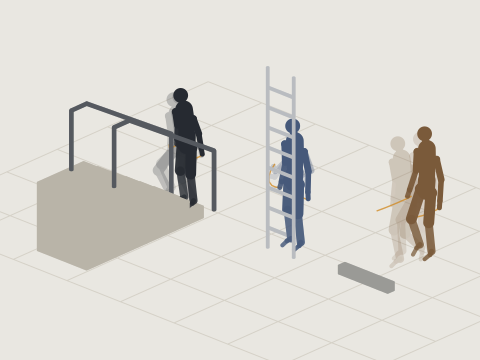
Loading the take.
Each person is a chain of typed actions from @automovie/motions. This is what an agent writes for the scene; Composing motion explains the parts.
import type { IAutoMovieMotionHumanBody, IAutoMovieMotionHumanPerformance } from "@automovie/interface";
import { HumanChain, HumanEmblem, HumanObject, HumanPerformance, HumanStance } from "@automovie/motions";
import * as archetypes from "@automovie/archetypes";

const stairs = archetypes.createStairs({ steps: 6, riser: 0.17, tread: 0.28 });
const stairsAt = { at: { x: -1.5, y: 0, z: 0.25 }, yaw: 0 };
const ladder = archetypes.createLadder({ rungs: 8, spacing: 0.3, kind: "fixed" });
const ladderAt = { at: { x: 0.5, y: 0, z: 0.35 }, yaw: 180, fixed: true };
const kerb = archetypes.createKerb({ kind: "kerb" });
const kerbAt = { at: { x: 2, y: 0, z: 0.31 }, yaw: 180 };

// dot: body f1, at (-1.5, 0) m, facing 0°, trained
const dot = HumanChain.subject("dot")
  .act("climbStairs", {
      pattern: "stepOverStep",
      count: 6,
      riser: 0.17,
      tread: 0.28,
      start: 0.05,
    })
  .act("look", {
      with: "trunk",
      cue: "seen",
      target: { kind: "person", subject: "eve", region: "face" },
      seconds: 1.5,
    })
  .act("gesture", { kind: "cheer" })
  .act("gesture", { kind: "clap", count: 4 })
  .registered("handsOnHips", { seconds: 1.2 })
  .act("gesture", { kind: "wave", count: 2 });

// eve: body m1, at (0.5, 0) m, facing 0°, trained
const eve = HumanChain.subject("eve")
  .act("climbLadder", { ladder: "ladder", rungs: 4 });

// fin: body m2, at (2, -1) m, facing 0°, trained
const fin = HumanChain.subject("fin")
  .act("walk", { to: { x: 2, y: 0, z: 0 } })
  .act("stepOver", { obstacle: "kerb" })
  .act("walk", { to: { x: 0.5, y: 0, z: 0.85 }, face: 180 })
  .act("touch", {
      target: { kind: "prop", subject: "ladder", point: "leftRail" },
      kind: "hold",
      hold: 3,
    })
  .act("look", {
      with: "head",
      cue: "seen",
      target: { kind: "person", subject: "eve", region: "face" },
      seconds: 1.5,
    })
  .registered("thumbsUp", {});

const scene = dot.with(eve, fin);

// The lexicon's laws this scene's rows perform, registered with the performance.
const laws = [HumanStance.handsOnHips, HumanEmblem.thumbsUp];

const props = [
  HumanObject.prop("stairs", stairs, stairsAt),
  HumanObject.prop("ladder", ladder, ladderAt),
  HumanObject.prop("kerb", kerb, kerbAt),
];

// Each body id's motion body, prepared from the site's measures.
declare const bodies: Record<string, IAutoMovieMotionHumanBody>;

const input: IAutoMovieMotionHumanPerformance.IInput = {
  seed: "climb",
  performers: [
    { subject: "dot", body: bodies["f1"]!, at: { x: -1.5, y: 0, z: 0 }, yaw: 0, proficiency: { level: "trained" } },
    { subject: "eve", body: bodies["m1"]!, at: { x: 0.5, y: 0, z: 0 }, yaw: 0, proficiency: { level: "trained" } },
    { subject: "fin", body: bodies["m2"]!, at: { x: 2, y: 0, z: -1 }, yaw: 0, proficiency: { level: "trained" } },
  ],
  composition: scene.node,
  props,
  laws,
};
const performance = new HumanPerformance(input);
Each person's actions on the film clock, with their named instants, as the engine placed them.
The timeline appears when the take is drawn.
The same composition in 4 takes on the player's clock. Each changes one choice and keeps the rest; the other takes are computed in this page, which takes a few seconds.