A short explanation
A speaker waves, opens his palms, points, counts to three, nods and gives a thumbs up.
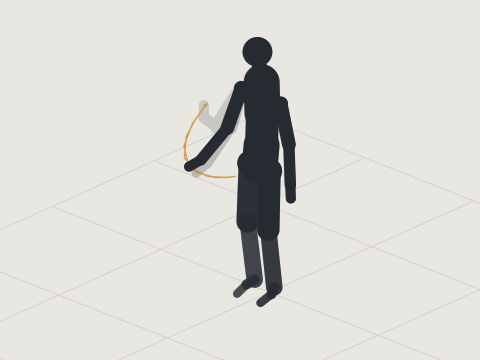
Loading the take.
Each person is a chain of typed actions from @automovie/motions. This is what an agent writes for the scene; Composing motion explains the parts.
import type { IAutoMovieMotionHumanBody, IAutoMovieMotionHumanPerformance } from "@automovie/interface";
import { HumanChain, HumanEmblem, HumanGestureRows, HumanPerformance, HumanRestRows, HumanUpperRows } from "@automovie/motions";

// sam: body m1, at (0, 0) m, facing 0°, trained
const sam = HumanChain.subject("sam")
  .registered("gestureWave", { count: 2 })
  .registered("gesturePalmsUp", { hold: 0.3 })
  .registered("pointAt", {
      target: {
        kind: "point",
        at: { x: -0.18, y: 1.35, z: 0.45 },
        frame: "world",
        normal: { x: 0, y: 0, z: -1 },
      },
      side: "right",
    })
  .registered("countOne", {})
  .registered("countTwo", {})
  .registered("countThree", {})
  .registered("gestureNod", { count: 2 })
  .registered("thumbsUp", {})
  .registered("restSide", { seconds: 0.8 });

const scene = sam;

// The lexicon's laws this scene's rows perform, registered with the performance.
const laws = [HumanGestureRows.gestureWave, HumanGestureRows.gesturePalmsUp, HumanUpperRows.pointAt, HumanEmblem.countOne, HumanEmblem.countTwo, HumanEmblem.countThree, HumanGestureRows.gestureNod, HumanEmblem.thumbsUp, HumanRestRows.restSide];

// Each body id's motion body, prepared from the site's measures.
declare const bodies: Record<string, IAutoMovieMotionHumanBody>;

const input: IAutoMovieMotionHumanPerformance.IInput = {
  seed: "upper-explanation",
  performers: [
    { subject: "sam", body: bodies["m1"]!, at: { x: 0, y: 0, z: 0 }, yaw: 0, proficiency: { level: "trained" } },
  ],
  composition: scene.node,
  laws,
};
const performance = new HumanPerformance(input);
Each person's actions on the film clock, with their named instants, as the engine placed them.
The timeline appears when the take is drawn.
The same composition in 4 takes on the player's clock. Each changes one choice and keeps the rest; the other takes are computed in this page, which takes a few seconds.